
Should you watermark a photo before posting it?
A visible mark is worth it on a photo you expect to be reposted and costs you clicks on a listing cover, and on its own it proves nothing about who took the shot. Tinolia stamps text or a small logo across a batch, and files are deleted within 1 hour.
Stamp · bottom right
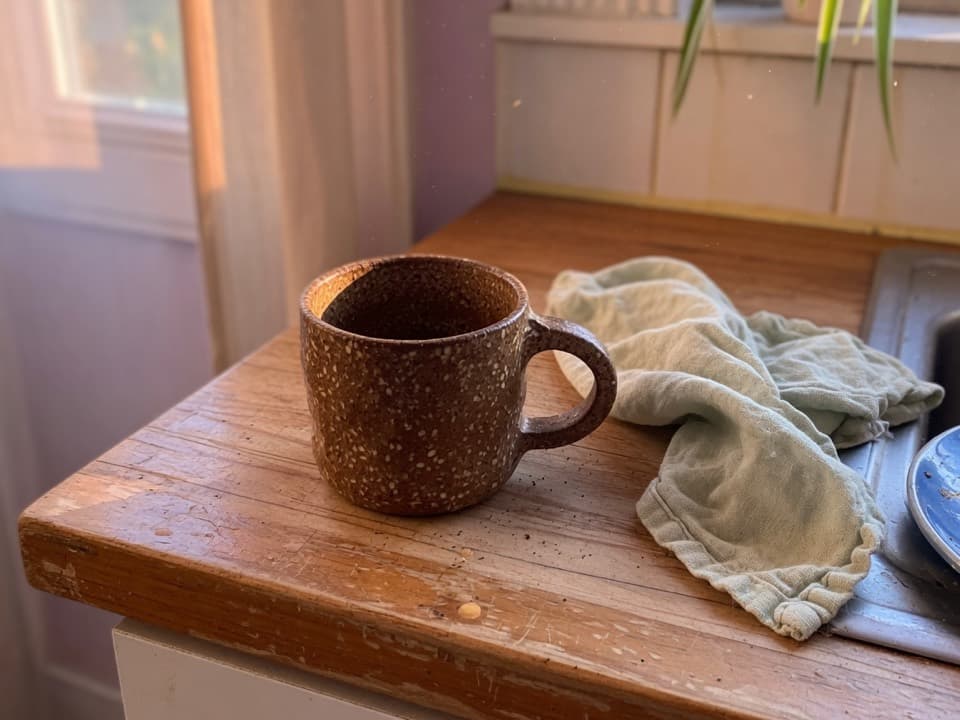
IMG_2041.HEIC → mug-marked.jpgRepeat off
What a watermark actually protects
A visible mark does one job well: it says where the image came from. Someone who runs into your photo on a reposted listing or a scraped blog can read the handle straight off the pixels, and that is usually enough to get it taken down without an argument.
It is a label, not a claim you can enforce. A watermark is not a copyright registration and not a C2PA signature, so it carries no proof that you pressed the shutter. The AI-generated preset works the same way: readable, not verifiable.
So the useful test is not whether a mark stops theft, because it does not. A mark earns its place when it survives the crop and stays legible at thumbnail size. One that gets trimmed off, or sits so faint that nobody reads it, is decoration with a cost.
Where to put it so the crop does not eat it
The usual spot is the bottom right corner, which is also the first thing a 1:1 listing card, a 4:5 crop, or a lazy screenshot removes. Anyone who wants your photo without your name trims a few hundred pixels off one edge and walks away with it.
What survives is a mark over the subject itself, or repeat turned on so the pattern covers the frame. Both are harder to look at and much harder to cut out, which is the whole trade.
- Crop the photo to the shape the platform shows before you place the mark.
- Put the text over the part of the subject you cannot afford to lose.
- Turn repeat on if a single mark still sits in a croppable corner.
How visible is too visible
Around 45 percent opacity is the balance point. Fainter and a bright sky swallows the text; heavier and people see the stamp before they see the mug. A mark you have to hunt for does no work at all, so faint is not the safe choice.
The cost lands on the click. A discreet handle in a repeated pattern reads as a photographer; a big diagonal banner with a price in it reads as a reseller who copied someone else's photo. Size the text so it is legible in the thumbnail and no larger.
eBay and Etsy read text on a photo differently
The platform decides how much mark you can get away with. A stamp from Watermark image that carries nothing but your handle is allowed on eBay, whose picture policy blocks borders and added text and then carves out a watermark identifying the seller. The price banner and the arrows are what get a listing pulled.
Etsy has no rule against it, but the shop card crops your first photo to its own shape, so a corner mark shows on the listing page and vanishes in the grid. If the mark matters at thumbnail size, it has to sit near the middle.
What it does not stop
Someone with an editor can crop past a corner mark, paint over a light one, or run a generative fill across it. A repeated pattern at real opacity makes that expensive rather than impossible.
The mark also does nothing about what sits under the pixels. GPS, camera model, and timestamp stay in the file until you strip them with Remove EXIF. If the photo is of your own house, do that first: strip GPS.
When not to watermark
Skip it on a Marketplace cover. The feed reads stamps and prices as junk and the cover is already the click, so a mark there costs more than it protects: listing photo size.
Skip it on anything a chat will recompress, because a faint mark comes out as mush on the other side: WhatsApp original. Skip it on document and ID uploads, where a portal wants the page unaltered, and on files going to a print lab, which will print the mark exactly as you left it.
Stamp the batch once you have decided
Watermark image takes up to 80 characters of text, or a logo file under 24 KB, and puts it in a corner, in the centre, or repeated across the photo. HEIC, JPEG, PNG, WebP, and AVIF all go in, up to 10 files, 20 MB each, and the marked copy comes out as JPEG.
A logo replaces the text stamp rather than joining it, and a PNG with a transparent background sits far better than a white box. iPhone HEIC is decoded through the same libheif path as HEIC to JPG, so the mark is baked into the pixels.
- Drop the photos on Watermark image.
- Type the handle or pick a small logo, then set the position and opacity.
- Turn repeat on if a crop would remove a corner mark, then download the files or the ZIP.
Questions
Does a watermark stop someone from reusing my photo?
A watermark stops the lazy repost and not the determined one. It makes reuse obvious and traceable, which is usually what gets a copy taken down.
Does a watermark prove I own the photo?
A watermark proves nothing on its own. It is a visible label, not a registration or a signature, and someone with an editor can try to paint it out.
Where should the mark go so a crop does not remove it?
Put the mark over the subject, or repeat it across the frame. A corner looks cleaner and disappears the moment someone trims one edge.
How visible should a watermark be?
Aim for legible in the thumbnail at around 45 percent opacity. Fainter and a bright background eats it; heavier and the stamp is what people look at.
Should I watermark a Marketplace listing photo?
Leave the listing cover unmarked. The feed treats stamps and prices as spam, and the cover is the one photo that has to win the click.
Can you remove a watermark from a photo?
Removing a watermark is not something Tinolia does. The watermark page only adds a mark, and undoing someone else's is not a job we take.
More guides like this
- Facebook Marketplace photo sizeThe feed card is near square, so crop 1:1, resize around 1200 px and upload JPEG. HEIC gets rejected, and the file usually still carries your address.
- Open iPhone HEIC photos on WindowsWindows ships no HEVC decoder for stills, so Explorer draws nothing. Install the two Store packages to look, or send JPEG to the portal that refused it.
- Open iPhone HEIC photos on AndroidAndroid 10 reads HEIF, but the gallery app decides. Google Photos usually opens it; a manufacturer gallery shows a grey tile. Convert and every app reads it.